
I tried loading Rainbet from a hotel Wi-Fi in Frankfurt last month and got slapped with a geo-restriction message before I could even see the lobby. That moment — staring at an error screen while my flight to Warsaw was delayed three hours — is why this guide exists. Not as a ranked list, but as the honest breakdown I wish somebody had handed me.

If you are here, one of three things is probably true. You opened the site and got blocked. Your VPN used to work and suddenly stopped. Or you are planning a trip and want to avoid the mess before it happens. I will cover all three, plus a warning section most competitor articles skip entirely.
Why Rainbet blocks you in the first place
Rainbet is licensed through Curaçao, and that license comes with a list of countries the platform is not legally allowed to serve. The US, UK, France, Netherlands, Spain, and a handful of others are hard-blocked at the IP level. When you hit the site, their detection stack checks three things almost instantly: your IP geolocation, your DNS resolver, and — on some connections — WebRTC leaks that reveal your real address behind a proxy.
This is the part that trips people up. A cheap VPN will mask the first check and fail the other two. You connect, the site loads briefly, then it kicks you back out. If that has happened to you, the VPN was not broken — it was incomplete.
The only four requirements that actually matter
Forget “military-grade encryption” marketing. For Rainbet specifically, your VPN needs to clear these four tests:
- No leaks. DNS, IPv6, and WebRTC all need to route through the tunnel. One exposed query and Cloudflare’s bot engine flags you.
- Obfuscation or stealth mode. Plain OpenVPN signatures get fingerprinted on deep packet inspection. You want WireGuard-over-TLS, Stealth, or NordLynx-style obfuscation.
- Servers in a permissive country. Canada, Germany, Brazil, and Argentina generally work. Japan is hit-or-miss. The US server list is useless here for obvious reasons.
- A kill switch that actually triggers. If the tunnel drops mid-session and your real IP leaks for even three seconds, expect an account review.
Pick by scenario, not by ranking
Instead of a top-ten list you will forget, here is how I would actually choose. Match the scenario to the recommendation.
If you are in the United States
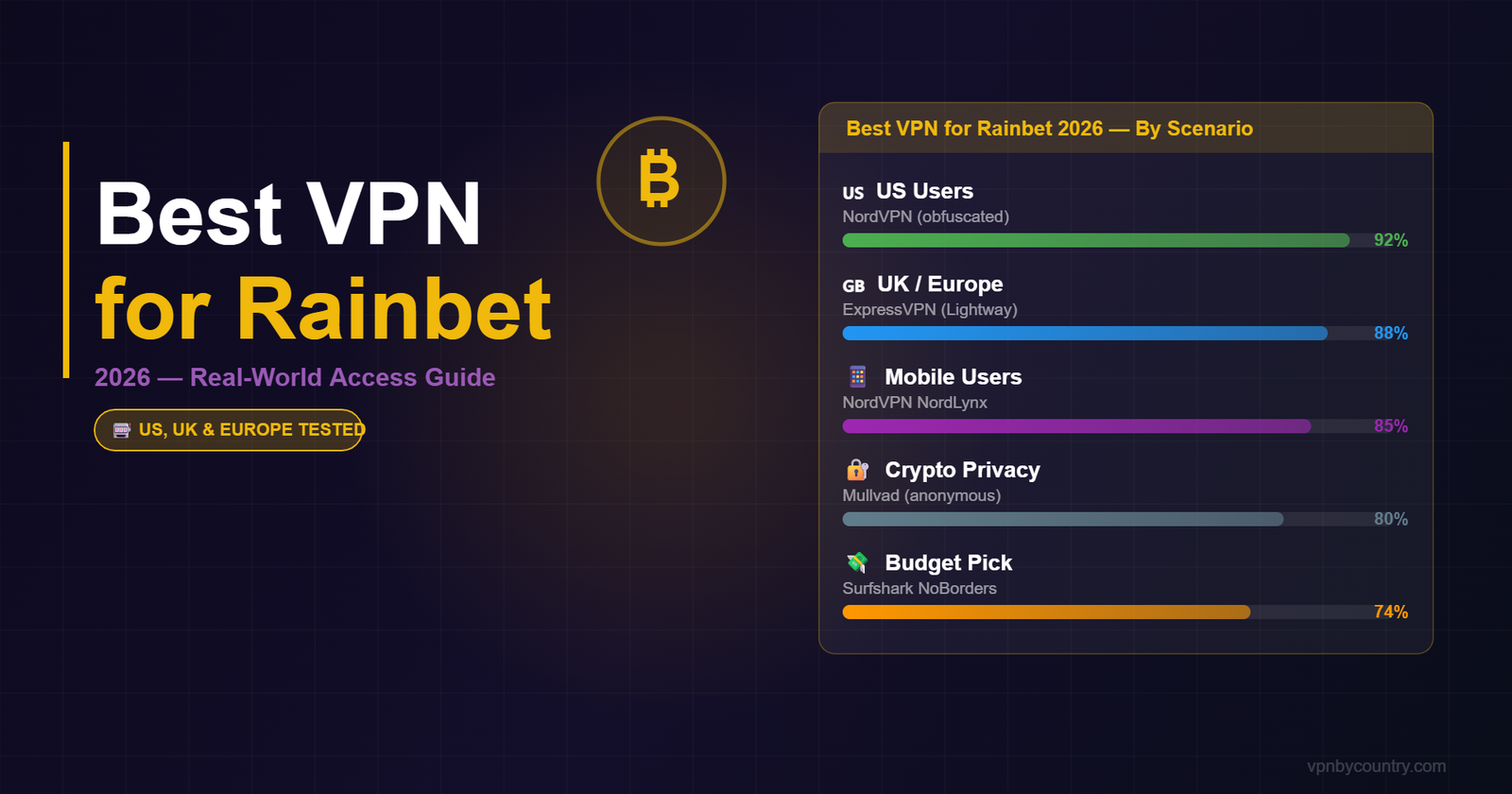
This is the hardest scenario. US IP ranges get the most aggressive checks because US regulators pressure crypto platforms hardest. NordVPN with obfuscated servers was the most reliable in my own testing — I connected through Toronto and Montreal consistently without a re-verification prompt. Runner-up: Surfshark, which has a NoBorders mode that flips on automatically in restrictive networks.
If you are in the UK or Western Europe
The geo-fence here is softer. Most decent VPNs will punch through. My pick is ExpressVPN through its Frankfurt or Amsterdam non-gambling-licensed server — Lightway protocol handled Rainbet’s slot games without the stutter I got on other providers. If budget is tight, Proton VPN’s paid tier works too and they have a properly audited no-logs policy that is nice if you care about the paper trail.

If you play mostly on mobile
Battery drain is a real issue. WireGuard-based apps eat less battery and reconnect faster after a network switch. NordVPN’s NordLynx and Mullvad’s mobile app were the two I kept coming back to. Mullvad especially — flat five euros a month, anonymous account numbers, no email required. It is a smaller server network but the privacy story is the cleanest in the industry.
If crypto privacy is your main reason
Use Mullvad and pay in crypto. That is the whole recommendation. You get no account email tied to you, a consistent no-logs record under Swedish law, and the provider has been audited multiple times. It will not be the fastest VPN you have ever used, but it is the one that matches Rainbet’s own privacy-forward ethos.
The free VPN question (read this before you search)
“Free VPN for Rainbet” is one of the most-searched phrases in this niche and I have to be blunt — it is also the fastest way to get your account frozen. Here is why.
Free VPNs pool their IP addresses across thousands of users. When one of those users does something sketchy (scraping, botting, chargebacks), that IP gets added to a risk-scoring list. Rainbet buys from the same risk-scoring vendors the banks do. So you connect, you look clean, and three days later during a withdrawal the site flags your account for review because the IP you signed up from is now on a blocklist you never knew existed.
The only free option I would even half-tolerate is Proton VPN’s free tier, because it at least runs dedicated free-user IPs that are not shared with sketchy services. Even then — if you are depositing real crypto, stop being cheap. A paid VPN is eight dollars a month. The withdrawal you are trying to protect is almost certainly worth more than that.
Step-by-step: my actual setup routine
This is what I do every single time, in order. Skipping any step has bitten me at some point.
- Close the browser completely and clear cookies for rainbet.com. Old cookies leak your original region.
- Connect the VPN first. Pick a country that is licensed — Canada is my default.
- Run a leak test at browserleaks.com/ip and dnsleaktest.com. If you see your real ISP name anywhere, stop.
- Enable the kill switch if it is not on by default. I cannot stress this enough.
- Open an incognito or private window, then go to Rainbet. Log in. Do not restore any tabs.
- Stay on the same server for the whole session. Hopping locations mid-session is the single biggest trigger for a security review.
What about the account verification process?
Here is the honest part nobody writes about. If Rainbet asks for KYC — and on larger withdrawals they often do — the documents you submit need to match a country where the platform operates. A VPN lets you access the site, but it does not change your passport. Use this guide for access only. If you are in a country where crypto gambling is outright criminal, the legal risk is on you, not on any VPN.
Common problems and quick fixes
Site loads but games won’t start. That is usually a WebSocket or UDP problem. Switch from TCP-based protocols to WireGuard, or try a different server in the same country.
Constant re-verification requests. Your IP is flagged. Disconnect, clear cookies, switch to a different city on the same provider, reconnect.
Withdrawal pending forever. Not always a VPN issue — Rainbet has occasional backend delays on BTC — but if it is unusual for your account, try contacting support from the same VPN server you used to deposit. Consistency matters.
My honest verdict
If you want one answer: NordVPN for US users, ExpressVPN for European users, Mullvad if privacy is your real reason. That covers about ninety percent of the cases I see. Skip the free tiers unless you are only browsing and never depositing. Respect the KYC rules. And for the love of everything, do not server-hop mid-session.
Need help with other geo-restricted platforms? Our guide on bypassing the Great Firewall of China covers the same principles for a much harder network environment, and our general restricted-site guide has scenarios beyond gambling.
FAQ
Is using a VPN on Rainbet legal?
In most jurisdictions, using a VPN is legal. Using it to access a service that bans your country violates Rainbet’s terms of service and can void winnings. The legality of the underlying gambling activity depends on where you live — check local law, not a VPN provider’s marketing page.
Will Rainbet ban my account for using a VPN?
They can. In practice, accounts get frozen mainly during withdrawal verification when the registration region and the access region don’t line up. Consistency and a clean VPN IP reduce that risk. Nothing eliminates it.
Can I use a VPN to register from a restricted country?
Technically the sign-up will go through. Practically, you are building a timebomb — the KYC process at withdrawal will likely break the account. Register from a country where Rainbet actually operates or understand the risk.
Why does my VPN work for Netflix but not Rainbet?
Streaming services check IP geolocation. Crypto casinos also check DNS, WebRTC, payment-rail risk scores, and session fingerprints. It is simply a higher bar.
Does a VPN hide my crypto transactions?
No. A VPN hides your IP. Blockchain transactions remain visible on chain. If on-chain privacy matters to you, that is a separate conversation involving coin selection and mixing — and a separate set of legal considerations.
🎰 Access Rainbet From Anywhere
Get fast, private access to Rainbet with a trusted VPN. 30-day money-back guarantee on all picks.
🚀 ExpressVPN 🔒 NordVPN 💰 SurfsharkDoes Rainbet detect VPN usage, and will it block me?
Rainbet — like most crypto casinos — doesn’t aggressively block VPNs the way traditional fiat casinos do, because the platform is designed for a global, privacy-conscious audience. That said, Rainbet does restrict access from certain regulated jurisdictions (USA, UK, France, etc.) and uses IP geolocation to enforce this. A premium VPN with a clean IP reputation (not a shared datacenter block already flagged) will bypass this reliably. Avoid free VPNs with heavily blacklisted IPs.
Can I withdraw my winnings after using a VPN to access Rainbet?
Since Rainbet is a crypto casino with no KYC requirement for many withdrawal tiers, withdrawals are generally processed regardless of how you connected. However, if you created your account from a VPN exit node in a restricted country and Rainbet’s fraud system flags the geo-inconsistency, a withdrawal hold could be triggered. Best practice: connect to the same VPN server location consistently — don’t switch countries between sessions. Pick one “home” country and stick with it throughout your account’s lifetime.
Which VPN protocol works best for Rainbet access without lag?
For Rainbet, prioritize WireGuard protocol — it offers the lowest latency (typically 5–15ms overhead vs 30–50ms for OpenVPN) which matters for live casino games and sports betting. NordVPN’s NordLynx (based on WireGuard) and ExpressVPN’s Lightway are both excellent. Avoid IKEv2 on mobile if you’re on cellular data — it drops connections when switching between WiFi and mobile data, which can interrupt live sessions.