
📰 Updated April 2026 — Trending Topic
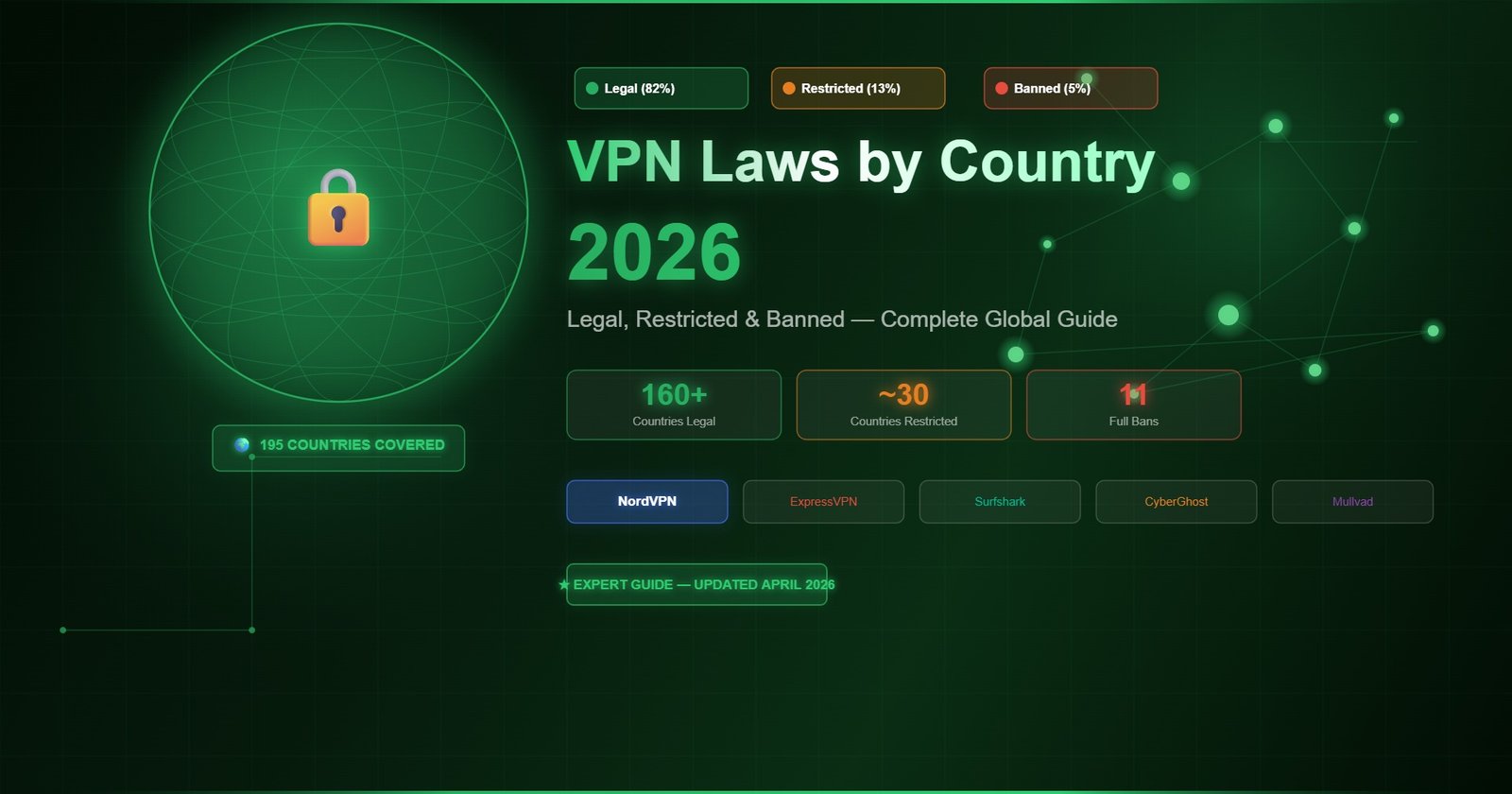
VPN Laws by Country 2026: Where Is It Legal (and Where It’s Not)
From China’s Great Firewall to Norway’s open internet — every country has different VPN rules. Here’s the complete 2026 global map of VPN legality, updated with the latest changes.
195Countries Covered
11With Full Bans
2026Updated
82%Countries: VPN Legal
🗺️ The Big Picture: VPN Legality in 2026
In approximately 82% of countries worldwide, using a VPN is completely legal and unrestricted. In about 11 countries, VPNs are fully banned or criminalized. Roughly 30+ countries have partial restrictions — allowing VPN use but banning specific activities (like bypassing censorship) or requiring VPNs to be “approved” by the government. This article maps every country, explains recent legal changes, and tells you what you actually need to know before using a VPN abroad.Countries Where VPNs Are Illegal (Full Bans)
These countries have enacted laws that explicitly ban or severely restrict VPN use for individuals. Penalties range from fines to imprisonment. Always research current laws before traveling to any of these destinations:
Illegal / Fully Banned
Restricted / Requires Approval
Legal / Unrestricted
→ Swipe left/right to see full table
| Country | VPN Status | Penalty | Notes |
|---|---|---|---|
| 🇨🇳 China | ❌ Banned (individuals) | Fines up to ¥15,000 | Only government-approved VPNs are legal. Enforcement is inconsistent — tourists rarely prosecuted, but risk exists. |
| 🇷🇺 Russia | ❌ Restricted | Fines, service blocking | VPNs must register with Roskomnadzor and block blacklisted sites. Non-compliant VPNs are blocked. User prosecution rare but possible. |
| 🇮🇷 Iran | ❌ Banned | Imprisonment possible | Only “approved” government VPNs (used by businesses) are legal. Personal VPN use is illegal. However, an estimated 40%+ of Iranians use VPNs. |
| 🇰🇵 North Korea | ❌ Completely Banned | Severe (imprisonment) | Internet access is virtually non-existent for ordinary citizens. VPNs are irrelevant as most have no internet access. |
| 🇹🇲 Turkmenistan | ❌ Banned | Fines, monitoring | Government controls all internet access. VPN use is illegal and monitored. One of the world’s most restrictive internet environments. |
| 🇧🇾 Belarus | ❌ Banned | Fines | 2015 law bans anonymizing tools. VPN sites are blocked at the ISP level. Used widely despite the ban. |
| 🇮🇶 Iraq | ❌ Banned | Unclear | Banned in 2014, ostensibly to fight ISIS-related communications. Enforcement is inconsistent. |
| 🇴🇲 Oman | ❌ Banned (personal use) | Fines up to $1,300 | VPNs are allowed for businesses with approval. Personal VPN use to access blocked content is illegal. |
| 🇦🇪 UAE | ⚠️ Restricted | Fines up to $545,000 | VPNs are legal for businesses and expats. Illegal use of VPN to commit a crime carries massive fines. Personal VPN use is technically legal if not used for “illegal” purposes. |
| 🇹🇷 Turkey | ⚠️ Restricted | Fines, ISP blocking | VPNs are frequently blocked by Turkish ISPs. Not criminalized, but government blocks major VPN websites. Obfuscated servers needed for reliable access. |
| 🇵🇰 Pakistan | ⚠️ Restricted | Legal uncertainty | PTA (telecoms authority) requires VPNs to be registered. Unregistered VPN use is in legal grey area. Widely used despite partial blocks. |
VPN Status by Region: Global Overview
✅ VPN Legal — No Restrictions
- 🇺🇸 United States
- 🇬🇧 United Kingdom
- 🇩🇪 Germany
- 🇫🇷 France
- 🇨🇦 Canada
- 🇦🇺 Australia
- 🇯🇵 Japan
- 🇸🇬 Singapore
- 🇧🇷 Brazil
- 🇮🇳 India
- 🇲🇽 Mexico
- 🇳🇱 Netherlands
- 🇸🇪 Sweden
- 🇨🇭 Switzerland
- 🇳🇴 Norway
- + ~150 other countries
⚠️ VPN Restricted / Grey Area
- 🇦🇪 UAE (legal but monitored)
- 🇹🇷 Turkey (blocked but not criminalized)
- 🇵🇰 Pakistan (registration required)
- 🇷🇺 Russia (must comply with blocking)
- 🇺🇿 Uzbekistan (state-controlled ISPs)
- 🇰🇿 Kazakhstan (ISP-level filtering)
- 🇪🇬 Egypt (some VPN sites blocked)
- 🇸🇦 Saudi Arabia (business VPNs OK)
- 🇦🇿 Azerbaijan (selective blocking)
- 🇻🇳 Vietnam (restricted but used)
❌ VPN Banned / Highly Restricted
- 🇨🇳 China
- 🇮🇷 Iran
- 🇰🇵 North Korea
- 🇹🇲 Turkmenistan
- 🇧🇾 Belarus
- 🇮🇶 Iraq
- 🇴🇲 Oman (personal use)
- 🇲🇲 Myanmar (since 2021 coup)
- 🇨🇺 Cuba
- 🇸🇾 Syria
- 🇪🇷 Eritrea
Latest VPN Law Changes: 2026–2026 Updates
USA — TikTok Near-Ban Triggers VPN Surge (January 2025)
The United States came within hours of a full TikTok ban in January 2025, causing a 500% spike in VPN downloads. The ban was paused, but government devices are still prohibited from running TikTok. VPN use remains fully legal in the US with no restrictions on usage.January 2025
Russia — Expanded VPN Crackdowns Continue
Russia blocked over 200 additional VPN services in 2026, including several major providers. NordVPN, ExpressVPN, and Surfshark remain accessible via obfuscated servers. Russian authorities fined Apple for distributing non-compliant VPN apps on the Russian App Store.2025
India — VPN Data Retention Law Enforced
India’s 2022 law requiring VPN providers to log and store user data for 5 years remains in force. NordVPN, ExpressVPN, and Surfshark all pulled their Indian physical servers and now serve Indian users via virtual servers located outside India. VPN use itself remains legal in India.Ongoing 2025–2026
European Union — No VPN Restrictions
VPN use remains fully legal across all 27 EU member states. The EU’s Digital Markets Act (DMA) and GDPR have actually increased European VPN adoption as users become more privacy-conscious. No EU country has proposed restricting consumer VPN access.2026
Pakistan — PTA Demands VPN Registration
Pakistan’s telecom authority (PTA) expanded its VPN registration program, requiring businesses and individuals to register VPN usage. Unregistered VPNs face bandwidth throttling. Despite this, VPN usage has grown significantly amid social media restrictions and WhatsApp blocks.2025–2026
Myanmar — Internet Blackouts + VPN Criminalization
Since the 2021 military coup, Myanmar has enacted some of the world’s most extreme internet restrictions. VPN use is technically criminalized, and the government conducts targeted surveillance of VPN users. Despite extreme risks, VPNs remain widely used by journalists and activists inside the country.2021–2026 (ongoing)
Key Countries Deep Dive: What Travelers Need to Know
If you’re traveling internationally, here’s a quick practical guide for the most-visited countries with VPN complications:China: Download your VPN before arrival — the NordVPN and ExpressVPN websites are both blocked in China. Enable obfuscated servers (NordVPN) or automatic obfuscation (ExpressVPN) before you land. Tourists using VPNs are rarely prosecuted, but enforcement has increased in recent years around sensitive events. Use a premium VPN only — free VPNs are essentially non-functional in China.UAE / Dubai: VPNs are technically legal for personal use, but using a VPN to access VoIP services (like WhatsApp calling, Skype calls) remains a grey area since VoIP is restricted. Business VPNs are explicitly legal. The massive fines cited in UAE law are aimed at criminal use of VPNs, not tourists. Practically, millions of expats use VPNs in the UAE daily without issue.Turkey: VPN websites are blocked by Turkish ISPs, but VPN apps downloaded before arrival work well. NordVPN’s obfuscated servers are recommended. Turkey regularly blocks social media platforms during political events — VPN demand spikes significantly during these periods. Not criminalized; just frequently disrupted.Russia: Many VPN websites are blocked, and non-compliant VPN apps have been removed from Russian app stores. Download your VPN before entering Russia. Premium VPNs with obfuscation (NordVPN, ExpressVPN) remain functional despite blocks. Prosecution of individual users is extremely rare.India: VPNs are completely legal in India. The main change is that VPN companies must now store user logs — meaning your VPN provider theoretically has data that could be subpoenaed by Indian authorities. NordVPN moved its servers outside India to comply while maintaining its no-logs policy. For Indian users prioritizing privacy, choose a VPN headquartered outside India (NordVPN is in Panama).Frequently Asked Questions
Can you go to jail for using a VPN?
In most countries, no. VPN use is legal in approximately 82% of countries. In the handful of countries where VPNs are banned (China, Iran, Turkmenistan, Belarus, etc.), penalties are typically fines rather than imprisonment for first-time individual users. However, in North Korea and Turkmenistan, internet-related laws are enforced with severe consequences. Using a VPN to commit other crimes — hacking, fraud, child exploitation — is separately prosecuted in every country.
Is using a VPN in China really illegal?
For individuals, technically yes — only government-approved VPNs are legal in China. However, enforcement is highly selective. Foreign tourists and business travelers using VPNs in China are very rarely prosecuted. Chinese citizens face somewhat higher risk, especially around politically sensitive times. The practical reality is that millions of people use VPNs in China every day with only occasional crackdowns. That said, understanding the legal risk exists is important before traveling.
Are VPNs legal in the United States?
Completely legal. The United States has no restrictions on VPN use — individuals, businesses, and government agencies all use VPNs without any legal risk. While the US is part of the 5-Eyes intelligence sharing alliance (a privacy concern), VPN use itself is protected activity. The only restriction is that federal government employees are prohibited from installing TikTok on government devices, which has driven VPN interest — but personal VPN use on personal devices remains entirely unrestricted.
Which VPN works best in countries with VPN restrictions?
NordVPN is our top recommendation for restricted countries, specifically because of its obfuscated server technology. Obfuscated servers disguise VPN traffic as regular HTTPS, defeating deep packet inspection (DPI) used in China, Iran, Turkey, Pakistan, and Russia to detect and block VPNs. ExpressVPN’s Lightway protocol offers similar capabilities with automatic activation. Both are significantly more effective than cheaper or free VPN options in high-restriction environments.
Does the UAE allow VPNs?
Yes, with caveats. VPNs are legal in the UAE for personal and business use. The massive fines you may have read about (up to 500,000 AED) apply to using a VPN to commit a crime — not simply using a VPN. Millions of expats use VPNs in Dubai and Abu Dhabi daily without legal issues. The main practical restriction is that VoIP services (WhatsApp calling, FaceTime audio, Skype) remain restricted even with a VPN — telecom companies actively prevent VoIP, and this is separate from VPN legality.
What should I do before traveling to a country with VPN restrictions?
Three steps: (1) Download and set up your VPN before you arrive — VPN websites are often blocked in restricted countries, making it impossible to sign up or download after arrival. (2) Enable obfuscated server settings in advance and test that they work. (3) Save the VPN’s customer support contact and a list of server IP addresses offline, in case you need to configure manually if the app can’t auto-connect. NordVPN provides direct server IPs for manual configuration if needed.
🌐 The VPN We Recommend — NordVPN
NordVPN combines top-tier security, blazing speed, and one of the largest server networks in the world. Whether for privacy, streaming, or bypassing blocks — it just works. Backed by a 30-day money-back guarantee.
Try NordVPN Now →30-day money-back guarantee · No-logs policy