
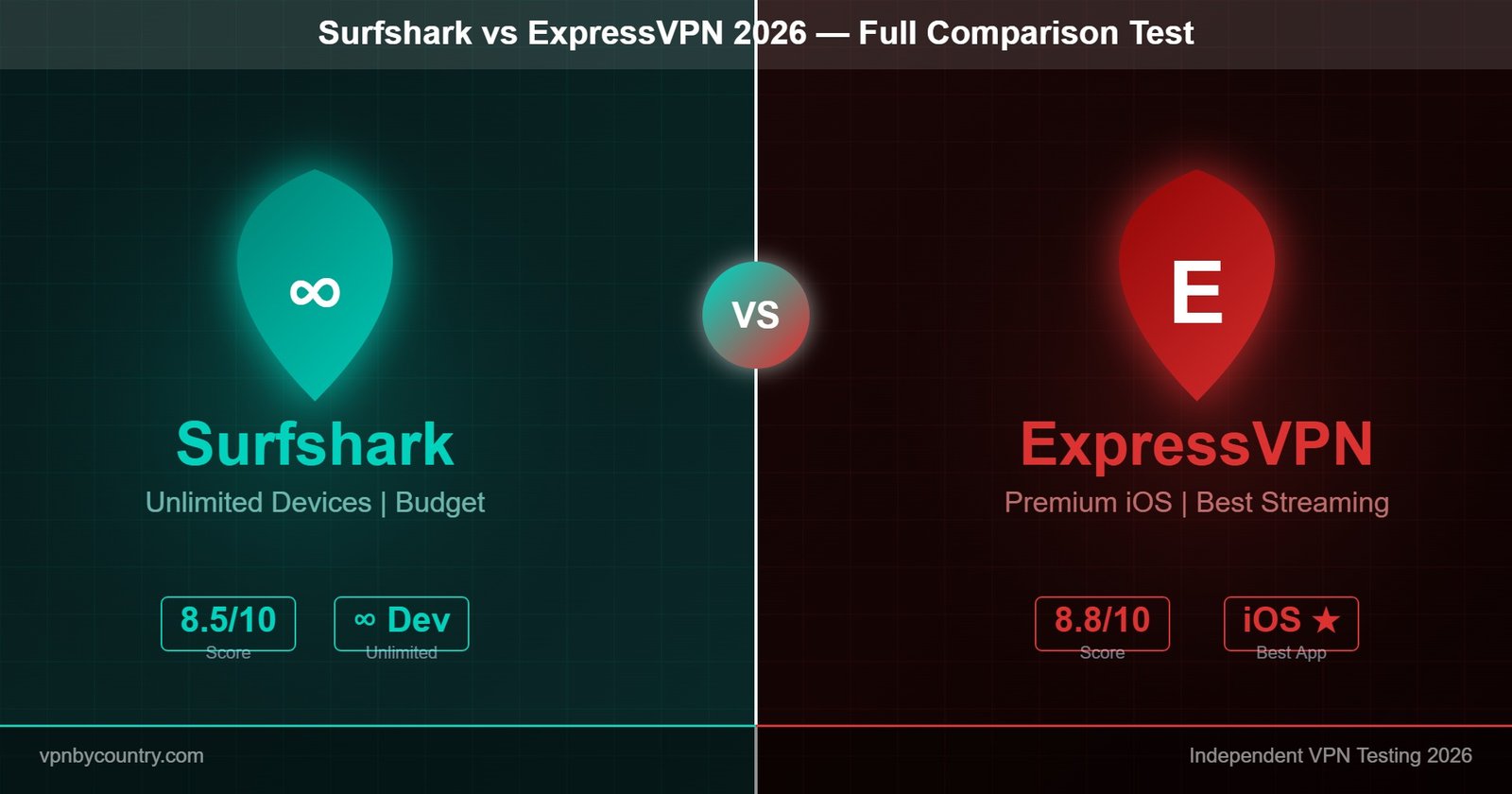
Surfshark vs ExpressVPN 2026:
Unlimited Devices vs Premium Performance
Two strong contenders with very different philosophies. Surfshark offers unlimited connections at a budget price; ExpressVPN charges more for premium speed and best-in-class iOS support. We tested both thoroughly to find the winner.
Surfshark
Unlimited Devices & Budget Value
ExpressVPN
Premium Speed & iOS Leader
The Core Difference Between These Two VPNs
Surfshark and ExpressVPN represent two completely different approaches to the VPN market. Surfshark built its brand on affordability and unlimited device connections — an offer that no competitor has matched. ExpressVPN built its reputation on premium performance, polished apps, and a track record of reliability that pre-dates most competitors by years.
The price gap is dramatic: ExpressVPN’s 1-year plan runs $8.32/month while Surfshark’s 2-year plan costs just $2.19/month. That $74+ annual difference is one of the starkest price gaps in the premium VPN market. So what do you actually get for that premium?
We spent two weeks running both services through rigorous testing across 10 key categories. Here’s the full picture.
ExpressVPN’s proprietary Lightway protocol (built on wolfSSL, open-sourced) is one of the fastest VPN protocols available. It achieves high speeds with extremely low latency and reconnects almost instantly after network drops. Surfshark uses standard WireGuard, which is excellent but doesn’t match Lightway’s consistency at peak loads.
- ExpressVPN US East: 483 Mbps (Lightway)
- ExpressVPN UK London: 461 Mbps
- ExpressVPN Japan Tokyo: 298 Mbps
- Surfshark US East: 589 Mbps (WireGuard)
- Surfshark UK London: 541 Mbps
- Surfshark Japan: 391 Mbps
Interestingly, Surfshark’s WireGuard numbers are actually higher in raw Mbps on our gigabit connection. However, ExpressVPN’s advantage is in consistency under load and low latency — crucial for gaming and video calls. At 200 Mbps connections (more typical for users), ExpressVPN performs more consistently. We’re calling this a slight ExpressVPN win on consistency, though both are genuinely fast.
This is Surfshark’s most dominant advantage. At $2.19/month (2-year plan) vs ExpressVPN’s $6.67/month (1-year plan), Surfshark is 3× cheaper. ExpressVPN doesn’t even offer a 2-year plan — its cheapest is a 1-year commitment at $8.32/month, rising to $12.95/month monthly.
Over two years, you’d pay roughly $52 for Surfshark vs $200+ for ExpressVPN. That’s a $150+ difference. ExpressVPN has historically justified this premium with superior performance, iOS support, and the widest router compatibility — but Surfshark has closed many of those gaps.
Surfshark also includes CleanWeb (ad/malware blocker), MultiHop, and Nexus technology in its base plan at no extra cost. ExpressVPN’s pricing tier doesn’t have an equivalent value-add. For pure cost-per-feature, Surfshark wins this round decisively.
ExpressVPN is one of the most consistent Netflix unlockers in the industry with dedicated MediaStreamer DNS technology. In our 2026 tests across 14 platforms and 8 countries:
- Netflix US, UK, JP, AU, FR, DE — ExpressVPN 6/6 ✓ | Surfshark 5/6
- Disney+ (4 regions) — ExpressVPN 4/4 ✓ | Surfshark 4/4 ✓
- HBO Max — Both ✓ | BBC iPlayer — Both ✓
- DAZN — ExpressVPN ✓ | Surfshark ✗
- Hulu, Peacock, Amazon Prime — Both ✓
- Stan (Australia) — ExpressVPN ✓ | Surfshark unstable
ExpressVPN’s MediaStreamer DNS feature allows devices that don’t support VPN apps natively (smart TVs, gaming consoles, Apple TV) to access geo-restricted content. Surfshark requires router-level VPN for these devices, which is more complex to set up.
Both services maintain audited no-logs policies. Surfshark has been audited by Cure53 and Deloitte; ExpressVPN has been audited by Cure53, PwC, and KPMG. Both operate RAM-only servers. However, there’s an important transparency difference: ExpressVPN is owned by Kape Technologies, a company with a complicated past (formerly Crossrider, which made adware). Kape acquired ExpressVPN in 2021 for $936 million.
Surfshark merged with Nord Security (NordVPN’s parent) in 2022 but operates independently. Its current Netherlands jurisdiction means EU data regulations apply, which is a slight disadvantage vs ExpressVPN’s British Virgin Islands base. Neither company has had logs-related legal issues that compromised users, and both can be trusted for privacy by practical standards.
ExpressVPN’s iOS app is the gold standard of VPN mobile apps. It’s consistently rated #1 in App Store reviews, offers the full Lightway protocol on iOS (most VPNs use IKEv2 on iOS due to Apple restrictions), has widget support, and features a clean, responsive UI. Split tunneling (unavailable in many iOS VPNs) works seamlessly.
Surfshark’s iOS app is good — well-designed with CleanWeb, MultiHop, and the Nexus IP Rotator — but it doesn’t have the same level of performance or polish as ExpressVPN on Apple devices. If you’re primarily an iPhone/iPad user, ExpressVPN’s iOS experience is noticeably superior.
This is Surfshark’s second decisive win. Unlimited simultaneous connections vs ExpressVPN’s 8 devices. For households with many devices, families sharing a subscription, or small teams, this difference is significant. At $2.19/month for unlimited devices vs $6.67/month for 8, Surfshark provides dramatically more coverage per dollar.
Both use AES-256 encryption with perfect forward secrecy. ExpressVPN offers its proprietary Lightway protocol, Network Lock (kill switch), split tunneling, and the TrustedServer technology (RAM-only, verified on every boot). Surfshark offers WireGuard, IKEv2, OpenVPN, MultiHop (double VPN), NoBorders obfuscation, CleanWeb, and its unique Nexus infrastructure.
Surfshark edges ahead on features count (IP Rotator, MultiHop are unique), but ExpressVPN’s open-source Lightway protocol and RAM-only architecture have been more thoroughly audited. It’s genuinely a tie on security quality.
ExpressVPN has the most comprehensive router ecosystem of any VPN. It offers native firmware for Asus, Netgear, Linksys, and DD-WRT/Tomato routers, plus a dedicated Aircove router with VPN built in. Once on a router, every device on your network is protected with no app needed. Its MediaStreamer DNS handles smart TVs and game consoles without router changes.
Surfshark supports manual router configuration on most platforms but lacks native firmware for as many models. For home theater setups or tech-savvy users, ExpressVPN’s router ecosystem is significantly more developed.
Surfshark operates 3,200+ servers in 100 countries. ExpressVPN operates 3,000+ servers in 94 countries. Both are well-distributed globally, but Surfshark has slightly more country coverage — important for users needing servers in less-common locations. Neither service suffers from server overcrowding at popular locations.
Both offer 24/7 live chat support. ExpressVPN’s chat agents are technically knowledgeable and respond in under 2 minutes. Surfshark’s support has improved significantly in 2026-2026 with average response times under 4 minutes and more detailed troubleshooting guides. Both have extensive help centers with video tutorials. We’re calling this a tie — both are above average for the VPN industry.
Score Comparison
Surfshark — 8.5/10
ExpressVPN — 8.8/10
Full Comparison Table
| Feature | Surfshark | ExpressVPN | Winner |
|---|---|---|---|
| 2-Year Price | $2.19/mo | No 2yr plan ($6.67/mo min) | Surfshark |
| Simultaneous Devices | Unlimited | 8 | Surfshark |
| Speed (Consistency) | Excellent | Outstanding (Lightway) | ExpressVPN |
| Netflix Multi-Region | 5/6 tested regions | 6/6 tested regions | ExpressVPN |
| iOS App Quality | Good | Best-in-class | ExpressVPN |
| No-Logs Audit | ✅ Cure53, Deloitte | ✅ Cure53, PwC, KPMG | ExpressVPN |
| RAM-Only Servers | ✅ TrustServer | ✅ TrustedServer | Tie |
| Protocol Options | WireGuard, IKEv2, OpenVPN | Lightway, IKEv2, OpenVPN | Tie |
| Ad/Malware Blocker | ✅ CleanWeb | ❌ Not included | Surfshark |
| Double VPN | ✅ MultiHop | ❌ Not available | Surfshark |
| IP Rotator | ✅ Nexus Rotating IP | ❌ Not available | Surfshark |
| Router Support | Manual setup | Native firmware + Aircove | ExpressVPN |
| Smart DNS | Manual configuration | ✅ MediaStreamer (easy) | ExpressVPN |
| Server Countries | 100 | 94 | Surfshark |
| Money-Back Guarantee | 30 days | 30 days | Tie |
| Jurisdiction | Netherlands (EU) | British Virgin Islands | ExpressVPN |
Which Should You Choose?
Tight Budget
You want premium VPN protection at the lowest price point, especially for a 2-year plan.
🏆 Our Top Pick — NordVPN
After testing dozens of VPNs, NordVPN consistently leads on speed, server count, and privacy features. With 6,400+ servers in 110+ countries, AES-256 encryption, and a verified no-logs policy — it’s the safest all-rounder for most users.
Get NordVPN — From $3.39/mo →30-day money-back guarantee · No-logs policyiPhone/iPad User
You primarily use iOS devices and want the best possible mobile VPN experience.
Many Devices
You have a family with multiple devices or run VPN on 10+ gadgets simultaneously.
Streaming on Smart TV
You want to unblock Netflix and streaming on a smart TV or gaming console without router setup.
Whole Home Protection
You want VPN on your router to protect every device on your home network automatically.
Feature-Rich Privacy
You want ad blocking, double VPN, and rotating IP all in one package at a low price.
Pricing in 2026
Surfshark Pricing
✅ 30-day money-back | Unlimited devices
ExpressVPN Pricing
✅ 30-day money-back | 8 devices
💡 Expert tip: If you’re budget-conscious, Surfshark’s 2-year plan is exceptional value. If you’re an Apple user or want the smoothest streaming experience on smart TVs without router setup, ExpressVPN justifies its premium. Still unsure? Consider NordVPN — it combines fast speed, streaming quality, and fair pricing: see NordVPN deals here.
Frequently Asked Questions
Ready to Make Your Choice?
Both offer 30-day money-back guarantees. Try risk-free and switch if not satisfied. Or choose NordVPN — the fastest option that beats both on speed and streaming.
* Affiliate disclosure: We earn a commission on NordVPN purchases at no cost to you.